Tamaño y participación del mercado de mermeladas en Europa
Visión general del mercado
| Periodo de estudio | 2021 - 2031 |
|---|---|
| Año base para la estimación | 2025 |
| Período de datos de pronóstico | 2026 - 2031 |
| Tamaño del mercado (2026) | USD 3.11 mil millones |
| Tamaño del mercado (2031) | USD 3.67 mil millones |
| Tasa de crecimiento (2026 - 2031) | 3.26% CAGR |
| Concentración de mercado | Media |
Principales actores *Descargo de responsabilidad: los jugadores principales están clasificados sin ningún orden en particular Imagen © Mordor Intelligence. Reutilización permitida bajo la licencia CC BY 4.0. | |
Análisis del mercado europeo de mermeladas por Mordor Intelligence
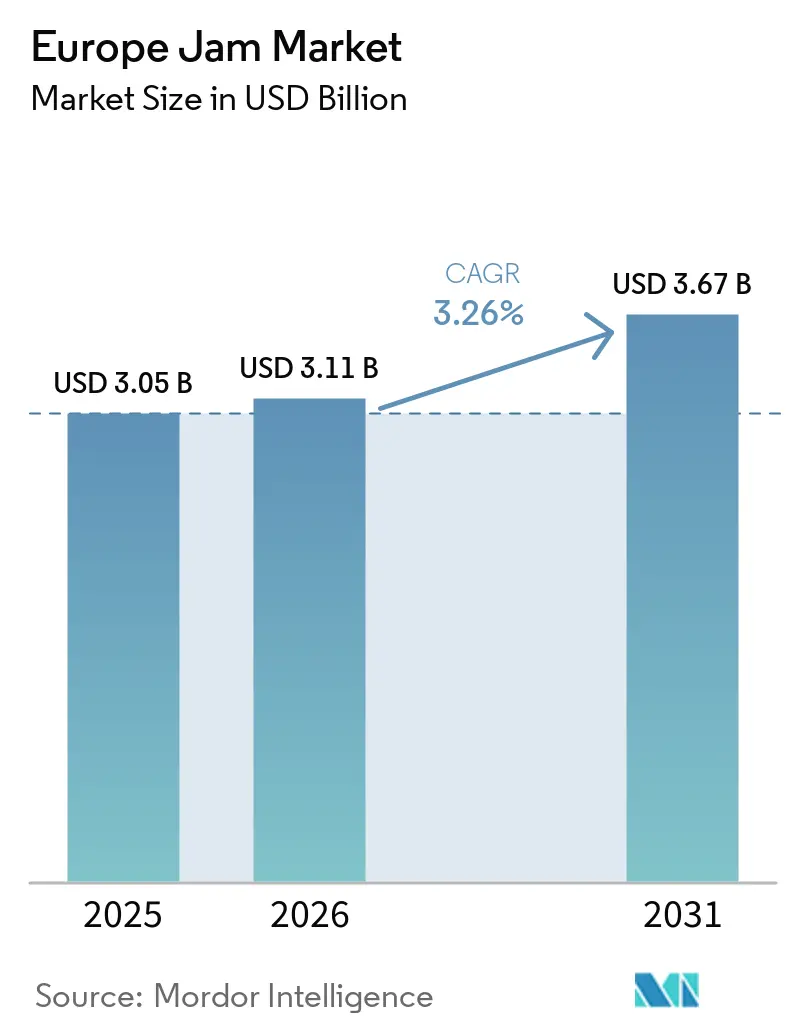
The Europe jam market size is projected to expand from USD 3.05 billion in 2025 and USD 3.11 billion in 2026 to USD 3.67 billion by 2031, registering a CAGR of 3.26% between 2026 and 2031. The Europe jam market is moving toward higher-value jars as buyers favor visible fruit content, clearer ingredient lists, and products with a stronger quality position. Directive (EU) 2024/1438 applies from June 14, 2026, and raises minimum fruit-content requirements for standard and extra jams, making reformulation and dependable fruit sourcing more important for suppliers[ 1 ]Source: European Parliament and Council, “Directive (EU) 2024/1438 of the European Parliament and of the Council of 14 May 2024,” Official Journal of the European Union, eur-lex.europa.eu.. This change favors producers that can manage higher fruit inputs and maintain consistent product quality across retail channels. Organic, reduced-sugar, and portion-controlled products create opportunities when they are supported by credible sourcing and practical packaging. Competition remains active because established brands, private labels, and smaller specialty producers all serve different price and quality needs in the Europe jam market.
Conclusiones clave del informe
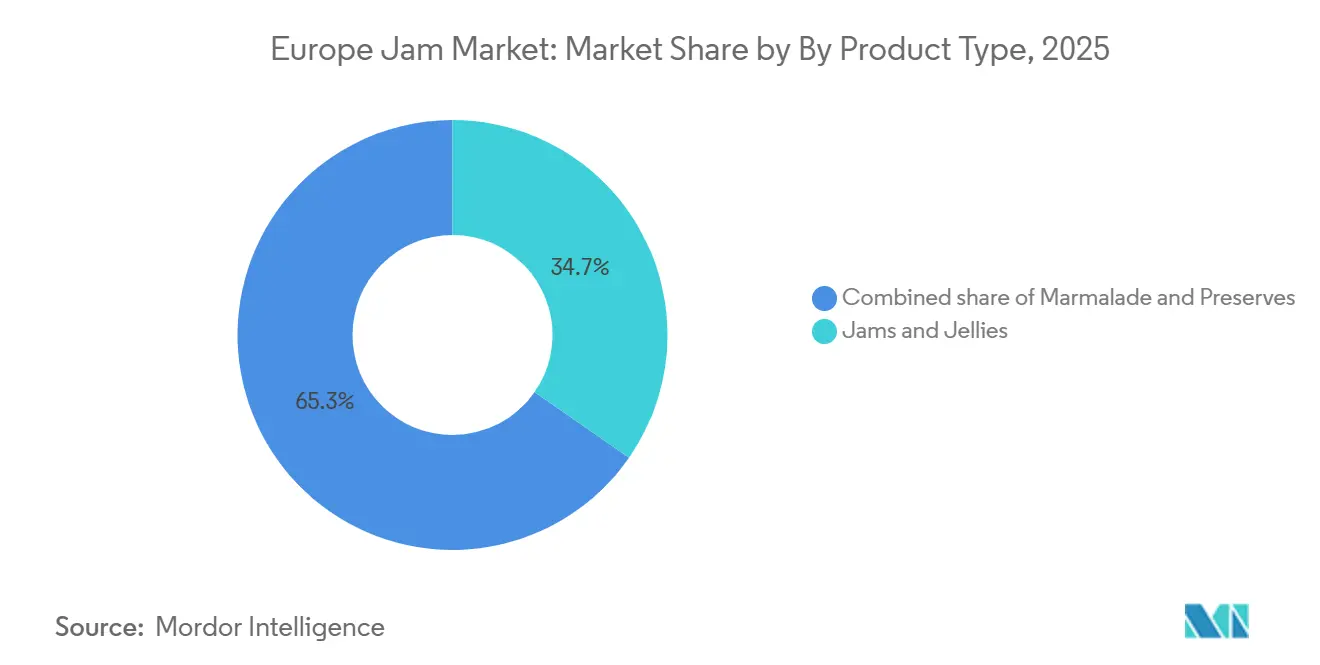
- By product type, jams and jellies held a 34.67% revenue share in 2025, while preserves are forecast to expand at a 4.20% CAGR through 2031.
- By category, conventional products held 86.43% revenue share in 2025, while organic variants are forecast to expand at a 5.65% CAGR through 2031.
- By packaging type, glass jars held 38.96% revenue share in 2025, while single-serve portion packs are forecast to expand at a 4.80% CAGR through 2031.
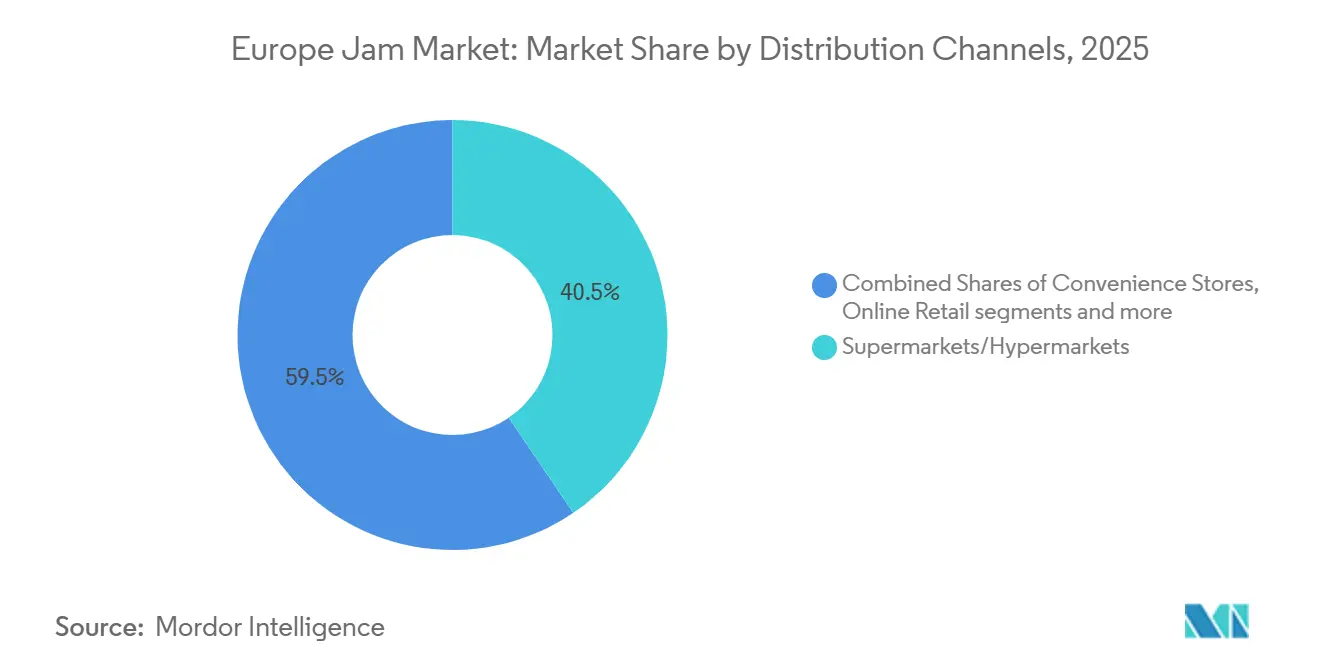
- Por canal de distribución, los supermercados e hipermercados representaron el 40.50% de los ingresos en 2025, mientras que se prevé que las tiendas minoristas en línea crezcan a una tasa de crecimiento anual compuesta del 5.10% hasta 2031.
- By geography, the United Kingdom held a 36.32% revenue share in 2025, while Germany is forecast to expand at a 4.80% CAGR through 2031.
Nota: El tamaño del mercado y las cifras de pronóstico en este informe se generan utilizando el marco de estimación patentado de Mordor Intelligence, actualizado con los últimos datos y conocimientos disponibles a enero de 2026.
Tendencias y perspectivas del mercado europeo de mermeladas
Análisis del impacto de los impulsores
| Destornillador | (~) % Impacto en el pronóstico de CAGR | Relevancia geográfica | Cronología del impacto |
|---|---|---|---|
| Rising demand for premium fruit jams | + 0.8% | Western Europe, including the United Kingdom, France, Germany, and Italy | Mediano plazo (2-4 años) |
| Reformulación de etiquetas limpias en toda la marca propia minorista | + 0.7% | Pan-European, strongest in Germany, the Netherlands, and Scandinavia | Corto plazo (≤ 2 años) |
| Crecimiento en el consumo de desayunos, refrigerios y alimentos para llevar. | + 0.6% | Pan-European, led by the United Kingdom, Germany, and France | Mediano plazo (2-4 años) |
| Expansión del comercio electrónico y de las marcas especializadas de DCC. | + 0.5% | Western Europe, particularly the United Kingdom, Germany, and the Netherlands | Mediano plazo (2-4 años) |
| Reducción de azúcar e innovación centrada en la fruta | + 0.4% | Pan-European, with compliance factors linked to Directive (EU) 2024/1438 | Corto plazo (≤ 2 años) |
| Expansión de marca impulsada por la exportación de productores europeos con larga tradición. | + 0.3% | Global export corridors, including the Gulf, Asia-Pacific, and North America | Largo plazo (≥ 4 años) |
| Fuente: Inteligencia de Mordor | |||
Rising Demand for Premium Fruit Jams
Premium products are reshaping the Europe jam market because consumers in the United Kingdom, France, and Germany are selecting jars with stronger fruit, origin, and craft credentials. This purchasing pattern places greater value on visible fruit content and trusted ingredient claims, particularly where a jar is bought as a small premium rather than a basic pantry item. Directive (EU) 2024/1438 requires more fruit in standard and extra jams, and it gives greater weight to products that can demonstrate their fruit composition on pack. The rule applies from June 14, 2026, so producers must already manage its formulation and labeling effects across existing lines and future launches. Heritage brands can use established sourcing relationships to support this positioning while newer brands need a similarly credible fruit story. The Europe jam market therefore rewards a clear quality proposition more than price-led messaging alone.
Clean-Label Reformulation Across Retail Private Label
Retailers are using short ingredient lists, reduced sugar, and organic fruit claims to strengthen private-label offers. This creates direct pressure on branded suppliers because similar product benefits are becoming available at lower price points. The Europe jam market benefits when reformulation gives shoppers a reason to remain in the fruit-spread category rather than choose alternatives. The EU organic agricultural area reached 17.4 million hectares in 2023, and the supplied USDA report expected a 14% increase by 2025 compared with 2022, expanding the potential certified raw-material base[ 2 ]Source: United States Department of Agriculture Foreign Agricultural Service, “EU Organics Market Begins to Recover,” GAIN Report, apps.fas.usda.gov.. Larger certified supply can help manufacturers develop compliant lines without relying on a narrow group of fruit suppliers or making ingredient claims that are difficult to sustain. Private-label growth also requires established brands to show why their fruit, taste, and format justify a premium for regular household purchases.
Growth in Breakfast, Snacking, and On-the-Go Consumption
More eating occasions support demand for convenient fruit jams in homes and hospitality settings. Hotels, airline lounges, and corporate canteens use single-serve packs because they are practical for individual service and make handling easier for staff. This supports the Europe jam market, where suppliers can meet foodservice requirements alongside retail demand without reducing the quality of the fruit proposition. Hero Group reported CHF 1,187 million in net sales in 2025, with 2.2% organic growth, and reported EBIT of CHF 71.3 million as it developed its Better Snacking platform. Its results show why convenient formats matter to companies serving changing snacking routines across several food occasions. Brands with suitable portion packs can reinforce visibility in venues where consumers later make retail choices.
Expansion of E-Commerce and DTC Specialty Brands
Digital channels allow small-batch producers to sell seasonal flavors and specialty products without waiting for broad supermarket listings. Subscription models can help these producers build direct relationships with buyers who value differentiated products and want to repeat a preferred purchase. The Europe jam market becomes more competitive when digital channels shorten the route from product trial to repeat purchase. Online storefronts also give brands room to present more flavors, gift options, and product detail than a physical shelf can hold. This can make it easier to test niche combinations before committing to wider distribution and larger production runs. Larger suppliers must maintain credible digital offers while protecting the efficiency of their supermarket business.
Análisis del impacto de las restricciones
| Restricción | (~) % Impacto en el pronóstico de CAGR | Relevancia geográfica | Cronología del impacto |
|---|---|---|---|
| Presión derivada de las tendencias de reducción de azúcar y calorías. | -0.4% | Pan-European, with regulatory influence from Nutri-Score labeling in France and Germany | Corto plazo (≤ 2 años) |
| Competencia de sustitutos como las cremas de frutos secos y las cremas para untar saladas. | -0.3% | Western Europe, led by the United Kingdom, Germany, and the Netherlands | Mediano plazo (2-4 años) |
| Presión sobre los precios de las marcas blancas en el comercio minorista masivo. | -0.3% | Pan-European, sharpest in high-discounter markets including Germany and Poland | Mediano plazo (2-4 años) |
| Volatilidad del suministro de fruta estacional y sensibilidad a los costos de los insumos | -0.2% | Mediterranean sourcing regions and Eastern European soft-fruit belts | Corto plazo (≤ 2 años) |
| Fuente: Inteligencia de Mordor | |||
Competition From Substitutes Such as Nut Butters and Savory Spreads
Nut butters and savory spreads compete for the same breakfast and snacking occasions. These alternatives appeal to consumers seeking protein-forward and filling products, particularly when they are choosing a spread for a routine weekday meal. The Europe jam market faces the strongest pressure among younger consumers who are open to varied spread formats. Fruit-spread producers can respond through authentic fruit provenance and products with higher fruit-to-sugar ratios that retain the category’s familiar taste. Competing directly on protein claims would be less credible than emphasizing the distinct taste and fruit content of preserves and jams.
Seasonal Fruit Supply Volatility and Input Cost Sensitivity
Soft-fruit sourcing remains exposed to weather conditions in Southern and Eastern Europe. Late frosts, uneven rainfall, and summer heat can reduce strawberry, apricot, and cherry yields by as much as 50% in adverse seasons. These changes raise input costs for manufacturers and make cost planning more difficult, especially when production commitments were set before a difficult harvest. The Europe jam market is especially challenging for smaller suppliers without multi-country sourcing or long-term contracted supply. Higher fruit-content requirements can add further pressure when raw fruit availability is limited. Companies with diversified procurement and reliable grower relationships are better positioned to protect continuity, manage price changes, and maintain consistent specifications for retail customers.
Análisis de segmento
By Product Type: Preserves Lead the Gourmet Opportunity
Jams and jellies held a 34.67% revenue share in 2025, supported by their broad availability in everyday retail. Their role in breakfast routines in the United Kingdom, France, and Germany sustains regular demand. The segment covers a wide price range that includes private-label products and artisanal offerings. This range gives suppliers flexibility even when some consumers reduce purchase frequency. Marmalade remains important in the United Kingdom and Spain, where citrus flavors and established serving occasions support a premium position. Preserves are forecast to grow at a 4.20% CAGR through 2031, making them the fastest-growing product type in the Europe jam market.
Preserves benefit from buyers seeking visible fruit, limited processing, and a more crafted product experience. These attributes fit the stricter minimum fruit-content rules under Directive (EU) 2024/1438. The category allows premium offers to stand apart from conventional jam products and alternative spreads. Suppliers can use differentiated flavor combinations to encourage trade-up without abandoning familiar fruit formats. Jams and jellies still matter because their scale supports efficient production and broad household access. Product planning can therefore balance cash-generating mainstream lines with preserves that offer stronger growth potential.
Nota: Las participaciones de todos los segmentos individuales están disponibles al momento de la compra del informe.
By Category: Organic Variants Advance From a Smaller Base
Conventional products held 86.43% of the Europe jam market size in 2025, reflecting their established retail presence and distribution scale. Their reach makes them essential for manufacturers that need broad shelf access and steady volumes. Organic variants are forecast to grow at a 5.65% CAGR through 2031. This rate exceeds the overall category pace and reflects interest in certified ingredients and clear product positioning. Germany’s organic food market reached EUR 18.23 billion, equivalent to USD 19.78 billion, in 2025 and grew 6.7% from 2024. Its scale makes Germany an important setting for organic fruit-jam launches.
France’s organic consumption market grew 3.6% in 2025 to EUR 12.6 billion, equivalent to USD 13.67 billion[ 3 ]Source: Agence Bio, “L’Agence Bio Dévoile les Chiffres du Marché et de la Production Bio 2025,” Agence Bio, agencebio.org.. The recovery in grocery demand gives suppliers a supportive setting for certified fruit jams. More organic farmland can improve access to compliant ingredients over time. Organic products still need trusted quality and a clear consumer benefit because certification alone does not secure repeat purchases. Reduced sugar and organic claims can work together when formulation remains familiar, and taste remains central. Conventional products retain their importance because price-sensitive households continue to anchor category volumes.
By Packaging Type: Single-Serve Packs Gain From Hospitality Demand
Glass jars held 38.96% revenue share in 2025, supported by their familiar shelf appearance and premium presentation. The format suits artisanal and higher-value products because it helps buyers see the product and recognize the brand. Glass also aligns with consumer interest in recyclable packaging. Squeezable plastic remains useful for convenient household use and families with children. Single-serve portion packs are forecast to grow at a 4.80% CAGR through 2031. Their demand is linked to hotels and other foodservice settings where individual portions are a hygiene and service requirement.
Portion packs give brands a way to remain visible in hospitality settings without relying on bulk dispensers. They also allow buyers to sample products before choosing them in retail stores. This gives brands with foodservice distribution an advantage when competing for breakfast venues. Packaging decisions now need to meet operational needs as well as sustainability expectations. A format must protect quality, communicate fruit content, and work efficiently in the intended channel. Producers that can manage these requirements are better able to serve both premium retail and institutional buyers.
By Distribution Channel: Online Retail Broadens Specialty Reach
Supermarkets and hypermarkets held 40.50% of the Europe jam market size in 2025, reflecting the category’s role as a routine grocery purchase. These retailers shape price competition and influence the visibility of private-label products. Convenience and grocery stores serve top-up and impulse needs in dense urban areas. Specialty food stores, farm shops, gift retailers, and direct foodservice supply support premium and artisanal offers. Online retail stores are forecast to grow at a 5.10% CAGR through 2031. Their growth reflects recurring grocery orders, wider digital discovery, and space for extended flavor assortments.
Online channels can reach consumers who may not encounter smaller brands in mainstream stores. They can support subscription models and direct communication around ingredients, flavor, and seasonality. This gives smaller producers a more practical path to validate demand. The Europe jam industry must manage this alongside supermarket operations that still provide scale and routine reach. A dual-channel approach can support volume products in physical retail and premium products through direct channels. Digital activity should complement supermarket execution rather than weaken the core retail business.
Nota: Las participaciones de todos los segmentos individuales están disponibles al momento de la compra del informe.
Análisis geográfico
The United Kingdom held 36.32% of the Europe jam market share in 2025, supported by deeply established breakfast and teatime consumption. Its position also reflects the continued role of well-known preserves brands in retail and hospitality. The United Kingdom remains receptive to premium jams that differentiate through quality, fruit content, and recognizable heritage. Italy, Spain, and the Benelux countries contribute through strong craft traditions and varied retail formats. Producers from these markets can support premium offers across Europe when they pair local recognition with reliable distribution.
Germany is forecast to grow at a 4.80% CAGR through 2031, the fastest rate among the geographic segments. Its organic food market reached EUR 18.23 billion, equivalent to USD 19.78 billion, in 2025 and expanded 6.7% from 2024. This scale supports continued interest in certified organic fruit jams and clear-label products. Germany also offers a practical setting for new product development because retailers and shoppers are responsive to organic and reduced-sugar positioning.
Russia, Poland, Sweden, the Netherlands, and Belgium represent a more varied group of opportunities for the Europe jam market. Poland remains important as a fruit-processing and trade partner for Western European supply chains. Sweden, the Netherlands, and Belgium show demand for organic certification, clean labels, and packaging with stronger sustainability credentials. The Rest of Europe grouping includes Austria, the Iberian Peninsula, and Southeastern European markets where specialty retail and hospitality channels can support steady expansion. Geographic strategies should match local sourcing, retail structures, and consumer preferences rather than rely on a single European approach.
Panorama competitivo
The Europe jam market has a moderately competitive structure because larger groups operate alongside strong regional specialists. Andros Group and Hero Group have broad brand and distribution capabilities, while regional suppliers compete through fruit quality, heritage, organic credentials, and specialty formats. Hero Group reported CHF 1,187 million in 2025 net sales and CHF 71.3 million in EBIT, supported by 2.2% organic growth. Its Hero 2035 strategy centers on Better Snacking and indicates a long-term shift toward products suited to changing food habits HERO GROUP. Such moves show that leading companies are combining portfolio direction with operating discipline. The Europe jam market rewards suppliers that can translate this strategy into dependable retail execution.
Directive (EU) 2024/1438 increases the importance of formulation capability and secure fruit supply because it raises fruit-content requirements for products sold as standard and extra jam. This places a higher burden on manufacturers that depend on lower-cost concentrate-heavy recipes. Larger and more integrated suppliers can use sourcing depth and reformulation resources to protect listings. Organic, no-added-sugar, and hospitality-ready formats are important areas because few producers combine all 3 at meaningful scale.
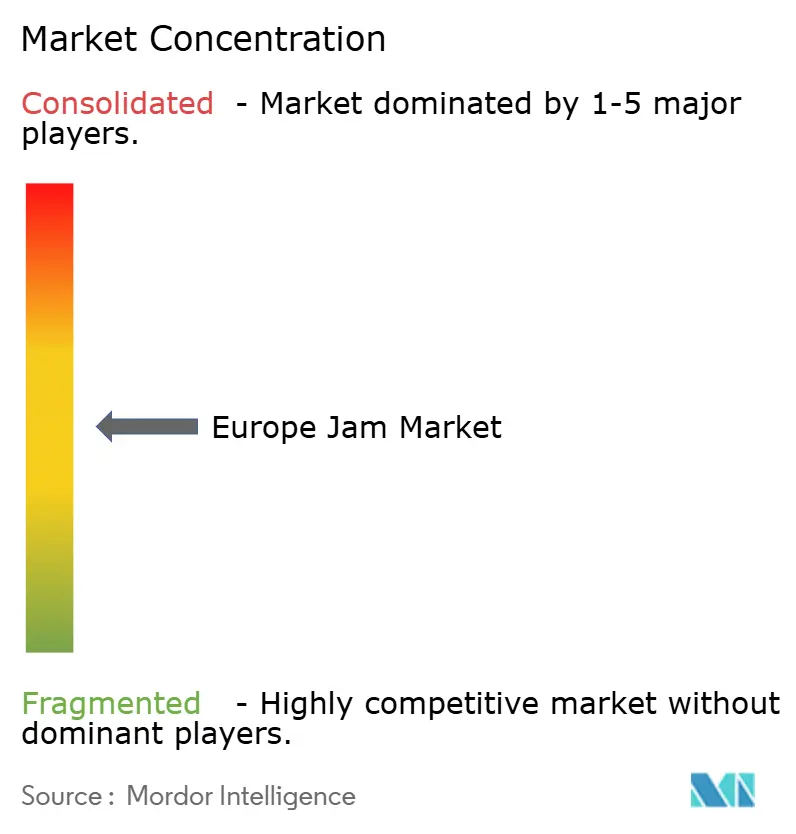
Digital-first brands add pressure by building an audience before seeking large supermarket listings. They can use direct selling to test flavors and learn which offers generate repeat purchases. Established brands can respond by improving their own digital routes and keeping product development close to consumer preferences. Private labels remain influential because they provide familiar products at accessible prices. A Europe jam market concentration score of 5 out of 10 reflects the presence of meaningful leading groups and durable regional competitors, without evidence that a small group controls the category at the threshold required for a higher score.
Líderes de la industria de las mermeladas en Europa
Alimentos Valeo
Zentis GmbH & Co. KG
Grupo Andros
Grupo de héroes
Darbo AG
- *Descargo de responsabilidad: los jugadores principales están clasificados sin ningún orden en particular
Desarrollos recientes de la industria
- Mayo de 2026: Fearne & Rosie, una marca de mermeladas con sede en el Reino Unido, ha ampliado su gama de conservas de fresa bajas en azúcar mediante una mayor distribución en las tiendas Tesco. Este avance pone de manifiesto la creciente demanda de productos para untar con menos azúcar por parte de consumidores y minoristas, y ha contribuido al rápido crecimiento de las ventas de la marca en el mercado británico de mermeladas.
- Abril de 2025: Hero Group adquirió el control total de MadreNatura, su empresa conjunta italiana de alimentos para bebés, que anteriormente estaba en manos de Angelini Holding en un 50%, consolidando así su presencia en el mercado italiano como parte de la estrategia de crecimiento de alimentos para bebés y niños pequeños y cremas para untar naturales.
- Mayo de 2025: Hero Group lanzó tarros de mermelada de vidrio rediseñados y más ligeros de 340 g en varios mercados europeos, utilizando un modelo de gemelo digital con inteligencia artificial para reducir el peso del vidrio en un 13 % y proyectando un ahorro de 700 toneladas de CO2e en el primer año, con planes para extenderlo a formatos y mercados adicionales.
Alcance del informe sobre el mercado de mermeladas en Europa
Jam is a sweet food product made by cooking fruit with sugar until it reaches a thick, spreadable consistency.
The scope of the report covers the Europe jam market, segmented by product type, category, packaging type, distribution channel, and geography. By product type, the market includes jams and jellies, marmalade, and preserves. By category, the market is divided into conventional and organic products. Based on packaging type, the market is segmented into glass jars, squeezable plastic, and single-serve portion packs. By distribution channel, the market includes supermarkets/hypermarkets, convenience/grocery stores, online retail stores, and other distribution channels. Geographically, the report covers Germany, the United Kingdom, Italy, France, Spain, Russia, the Netherlands, Poland, Belgium, Sweden, and the rest of Europe. The market sizing has been done in value terms in USD for all the above-mentioned segments.
| Mermeladas y Jaleas |
| Mermelada |
| Mantiene |
| Convencional |
| Organic |
| Jarras en vidrio |
| Plástico comprimible |
| Paquetes de porciones individuales |
| Supermercados / Hipermercados |
| Tiendas de conveniencia/supermercados |
| Tiendas minoristas en línea |
| Otros Canales de Distribución |
| Alemania |
| Reino Unido |
| Italia |
| Francia |
| España |
| Russia |
| Netherlands |
| Polonia |
| Bélgica |
| Suecia |
| El resto de Europa |
| Por tipo de producto | Mermeladas y Jaleas |
| Mermelada | |
| Mantiene | |
| Por categoría | Convencional |
| Organic | |
| Por tipo de embalaje | Jarras en vidrio |
| Plástico comprimible | |
| Paquetes de porciones individuales | |
| Por canal de distribución | Supermercados / Hipermercados |
| Tiendas de conveniencia/supermercados | |
| Tiendas minoristas en línea | |
| Otros Canales de Distribución | |
| Por geografía | Alemania |
| Reino Unido | |
| Italia | |
| Francia | |
| España | |
| Russia | |
| Netherlands | |
| Polonia | |
| Bélgica | |
| Suecia | |
| El resto de Europa |
Preguntas clave respondidas en el informe
What is the projected value of the Europe jam market by 2031?
The Europe jam market is projected to reach USD 3.67 billion by 2031, from USD 3.11 billion in 2026, at a 3.26% CAGR.
¿Qué tipo de producto está creciendo más rápido en Europa?
Preserves are forecast to grow at a 4.20% CAGR through 2031, supported by demand for visible fruit and more premium products.
Which channel has the strongest growth outlook for jam sales?
Online retail stores are forecast to grow at a 5.10% CAGR through 2031, supported by subscriptions, digital discovery, and broader flavor assortments.
Which European country leads jam consumption?
The United Kingdom held 36.32% revenue share in 2025, reflecting its established breakfast and teatime traditions.